Blog

  • Yale Center For British Art—Data Source Description

    Yale Center For British Art—Data Source Description

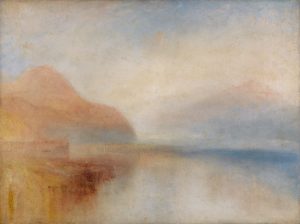
    JMW Turner, Inverary Pier, Loch Fyne: Morning

    The YCBA (@YaleBritishArt) has been sharing high-resolution images of its collection objects in the public domain since Yale University adopted its Open Access Policy in 2011, and today about 71,000 such images are available for download free of charge, including for commercial usage: http://britishart.yale.edu/collections/search

    The YCBA also makes its images available as IIIF assets. We publish a top-level collection that contains child collections for paintings, sculpture, etc.   The collections contain the IIIF Manifests for each object.   

    Machine readable YCBA data can be accessed currently by harvesting XML metadata (LIDO XML)and querying Linked Open Data semantic endpoint (data organized there with CIDOC CRM ontology). Access to or use of the Center’s data and services is subject to the Center’s Open Data And Data Services Terms of Use.

  • How to get involved with Coding Dürer

    How to get involved with Coding Dürer

    We have received more than 160 applications from all over the world to participate at Coding Dürer and many have engaged with us since then via social media. There is a strong interest in taking part in the event. 

    Here is the good news: We like to have as many people involved in Coding Dürer as possible. Read on to see how you can be part of it.

    Via Social Media

    Social Media are not only a channel to push news, but to interact.

    We would welcome if you follow our hashtag #CodingDurer at Twitter, get in contact with users, reply to tweets and ask your own questions. 

    Via Livestream

    We are offering parts of the event as livestreams. 

    Take a look at the list of streams and be online when our speakers give their presentations.

    Via Public Event

    The presentation of the project results will be public at the Department of Art History, Zentnerstr. 31 (Room 007) on Friday, 17.3., at 15:00.

    You are welcome to join us and be part of the conversation.


  • Museum für Kunst und Gewerbe Hamburg—Data Source Description

    Museum für Kunst und Gewerbe Hamburg—Data Source Description

    With approximately 500,000 objects from 4,000 years of human history, the Museum für Kunst und Gewerbe Hamburg (MKG) is one of Europe’s most important museums of art and design.

    The digitised and published parts of the collection are accessible online via MKG Collection Online.  The website features more than 10,000 artworks and artifacts. The LIDO-XML dataset that is provided via GitHub contains metadata of all the published records including links to the connected images, if available. More than 7800 images are reusable without any restrictions and can also be downloaded directly via the website. Please note our usage guidelines, if reusing images that are marked CC0 or CC BY 3.0. The collection can also be accessed via the websites and APIs of Europeana or Deutsche Digitale Bibliothek but the data updated most recently is the LIDO-XML on GitHub.

    A tool that has been developed during the hackathon “Coding da Vinci Nord” as part of the “Zeitblick” project and that can be useful is the MKG Downloader. This tool lets you filter items from the LIDO-XML and download them.

    The metadata includes information about artist/actor, actor role, object type, title, eventtype, date and place, material, technique, dimensions, marks and inscription, classification, iconography/subject, depicted persons, depicted place, description and rights metadata. The vocabulary used for cataloguing is in large parts linked to the Integrated Authority File (GND), to Wikipedia and Geonames, as well as to thesauri like Iconclass and the Art and Architecture Thesaurus (AAT). All persons and corporate bodies are linked to their respective GND record, if available.

    The datasets are placed in the public domain using a CC0 License.

    If you find any errors or want to provide additional information, please let us know.

    Contact: Antje Schmidt, Head of Digital Cataloguing and MKG Collection Online

    Email and Twitter

    #mkghamburg

  • Nationalmuseum Sweden—Data Source Description

    Nationalmuseum Sweden—Data Source Description

    About Nationalmuseum

    The Nationalmuseum in Stockholm is Sweden’s premier museum of fine art and design. Founded in 1866, the institution holds the growing national collection of older art up to around 1900 and older applied art as well as design up to the present day.  Our mission is to preserve, make accessible and provide knowledge about the collections we hold. Nationalmuseum is currently under renovation and will reopen to the public in 2018. 

    The Data

    The digitised collections of the Nationalmuseum Sweden are largely accessible via Europeana.eu where artworks that no longer are protected by copyright are licensed with CC BY SA or marked Public Domain. We would like to raise special attention to a dataset of around 3000 paintings which were made available on Wikimedia Commons last autumn.  Metadata to the images is reachable on Wikidata  and we  published the LIDO XML of all artworks as a zipped file on GitHUB. The XML holds information on the artist, title, media- and dimension information and often information on the depicted persons of the artwork. Each dataset includes a link to an iiif-resource, so that the image material can be used as flexible as possible. 

    The information has been collected in the internal database of the Nationalmuseum over a long period of time and might occasionally be incomplete or erratic. Additional data or corrections are welcome.  

    Contact Karin Glasemann via Twitter or Email

    .

  • Get #InspiredbyEuropeana at Coding Dürer

    Get #InspiredbyEuropeana at Coding Dürer

    Are you one of the art historians and data-scientists taking part in the Coding Dürer hackathon? Do you want to know what Europeana offers for research? Like the organisers of Coding Dürer, we believe that digitized cultural heritage content has huge potential for digital humanities and multidisciplinary research.

    Europeana offers the hackathon participants access to more than 54 million digitised items and related metadata from more than 3500 of Europe’s galleries, museums, archives and libraries. Europeana Art is our dedicated thematic collection designed to promote discovery of Europe’s art. Here you can browse 1.4m objects, get inspired by specially curated editorial features and search by topic, artist, museum and colour. Encouraging people to give new life and meaning to our re-usable content – currently  20.8m records in our entire collection – is one of the ways we can harness the full value of cultural heritage.

    On Europeana Labs you can access a range of resources and services to help you get working with our cultural collections as quickly and as easily as possible. There, you can find a showcase of tools and applications built using the Europeana API and a series of openly licensed datasets featuring the best free-to-re-use Europeana content. We have made available four Europeana APIs –  all are free to access and use after a simple registration process. The REST API is the most frequently used – it enables users to filter records by a variety of data fields, from date and creator, to media type and size. The Europeana Linked Open Data service allows you to explore, access, and download metadata through our SPARQL endpoint. With the Europeana OAI-PMH service, users can harvest the entirety, or a selection of all Europeana metadata. Finally, the Europeana Annotations API allows users to generate, update, and retrieve annotations for objects in our collections.

    Your use of Europeana data does not have to stop at Coding Dürer

    On our platform you can also find funding and services to support creative, educator and researcher communities to reuse Europeana content. About twice a year we issue the Europeana Challenge, a themed call to creative professionals to present their best business ideas for the re-use of Europeana content. Outcomes are varied; business-oriented or educational, social or creative, but the proposals must be sustainable and meet the theme (which in the past has included fashion, art, and World War I). In 2017 we have also launched the first Europeana match funding call offering financial backing for proposed secondary educational resources using Europeana content.

    Europeana Research provides opportunities for digital humanities researchers to answer a specific research question using Europeana content and research datasets. The annual Europeana Research Grants programme, first launched in 2016, is designed to support researchers employing  digital humanities tools and methods to make the most of the full resources of Europeana (metadata, the API, etc.) to further their research.  You can also become a member of Europeana Tech, our R&D community with a special focus on cultural heritage.

    We are pleased that the team at Coding Dürer has facilitated this hackathon of art history data. We are even more thrilled that we have the opportunity to encourage you to explore beyond interdisciplinary research boundaries with Europeana’s art data. If you use our content or API, please share your progress with us on Twitter using @EuropeanaLabs and #CodingDurer. We are interested in featuring any promising ideas or prototypes that come out of the Coding Dürer Hackathon on Labsemail us to show us more. For now, all the best for a productive and inspiring week at Coding Dürer – we are looking forward to seeing the outcomes. #Allezculture!

    Stay in touch!

    Europeana Labs website / newsletter sign up / Twitter / email us
    Europeana Research website / Twitter
    Europeana Tech website / Twitter  


  • RKD-Netherlands Institute for Art History—Data Source Description

    About the RKD

    The RKD is a renowned documentation and research institute. As a knowledge institute we work in collaboration with museums, heritage institutes, universities and private institutes. Members of our staff are involved in research, publications and organising events. We harbour unique archives, documentation and photographic material and the largest art historical library on Western art from the Late Middle Ages to present, with the focus on Dutch, Southern and Northern Netherlands, art. Our collections contain information on tens of thousands of paintings, drawings and sculptures, but also cover monumental art, modern media and design.

    RKD is publishing substantial parts of its data through (beta) web services. All sets are made available under ODbL-BY  (Open Database Licence – Attribution). Note: this licence is for the metadata only. Images are not licenced, although they might be in the public domain. RKD is currently exploring the options around Open Access and Content. All suggestions are welcome.

    RKDimages web service (OAI-PMH)

    The RKDimages web service is made for application developers and others who want to consult the data from RKDimages in machine-readable format. Through this web service descriptive data  is offered for around 240,000 works of art from the Middle Ages to the present day. 

    This data set is made available under ODbL-BY  (Open Database Licence – Attribution). The web service works on the basis of the Open Archives Initiative Protocol for Metadata Harvesting OAI-PMH. The format is RDF and using DC-Terms, FOAF en Schema.org: namespaces.

    Please note that the license concerns the descriptive data. Images can be retrieved in low resolution with watermark, but these are not yet available as open content.

    RKDartists web service/Open Search (EAC-CPF)

    This is a derivative set of biographical data from the extensive dataset RKDartists&. Containing biographical data of some 250,000 Dutch and foreign artists from the Middle Ages to the present. The ampersand in the name indicates that also art dealers, art collectors and art historians are included in this database. RKDartists serves also as an index to the extensive art historical documentation of the RKD. That analog documentation (images, archives, press documentation and literature) can then be viewed at the RKD. RKDartists is used by other (Dutch) heritage institutions as authorized name authority file in their own collections.

    The displayed elements are made available under the Encoded Archival Context for Corporate Bodies, Persons, and Families (EAC-CPF) standard. Each object (artists record) can be accessed via a URI (Uniform Research Identifier). Also there is in the data a deep link to the full record in RKDexplore.

    This data set is made available under ODbL-BY  (Open Database Licence – Attribution).

    And ICONCLASS as LOD

    Iconclass is a classification system designed for art and iconography. It is the most widely accepted scientific tool for the description and retrieval of subjects represented in images (works of art, book illustrations, reproductions, photographs, etc.) and is used by museums and art institutions around the world. So you can find the iconclass codes in many collection information systems. Although it’s considered a complex system with a high learning curve, Iconclass is second to none as a system for art (historical) subject annotation. The Iconclass system is accessible through the Iconclass  Browser and available as Linked Open Data (LOD)

    Please check the list of data sources for more information on these data sources
  • Albertina, Vienna—Data Source Description

    Albertina_Logo

    The Albertina safeguards one of the most important and extensive graphic art collections in the world. It comprises around 50,000 drawings and watercolours, as well as some 900,000 graphic art works, ranging from the Late Gothic era to the present.

    The arc of exquisite works stretches from Leonardo da Vinci, Michelangelo Buonarroti and Raphael Santi through Albrecht Dürer, Peter Paul Rubens and Rembrandt Harmensz van Rijn to Claude Lorrain, Honoré Fragonard and Paul Cézanne. In the modern section, the holdings range across Egon Schiele, Gustav Klimt and Oskar Kokoschka via Pablo Picasso and Jackson Pollock to Robert Rauschenberg, Andy Warhol, Alex Katz, and finally to Franz Gertsch, Georg Baselitz and Anselm Kiefer.

    Albertina is publishing a wide range of its works that are free of artist’s copyright in the Europeana collection. For CodingDürer Albertina is providing metadata from all its artworks that are published in Europeana collection. These datasets are placed in the public domain using a CC0 licence.
    Images are not included and are not part of the dataset.

    There are about 58.000 objects published in Europeana, amongst them about 40.000 drawings and prints from the Graphische Sammlung, 9.000 objects from the Fotosammlung, 5.500 objects from the Architektursammlung, 3.700 objects from the Plakatsammlung and some objects from the Gemälde- und Skulpturensammlung).

    Albertina is providing the following metadata concerning the work of art: title, creator, classification type, medium, size, creation date, provenance, identifier (= inventory number), institution, providing country, collection (is part of: Graphische Sammlung, Fotosammlung, Architektursammlung, Plakatsammlung, Gemälde- und Skulpturensammlung).

  • DAC Open Access Images—Data Source Description

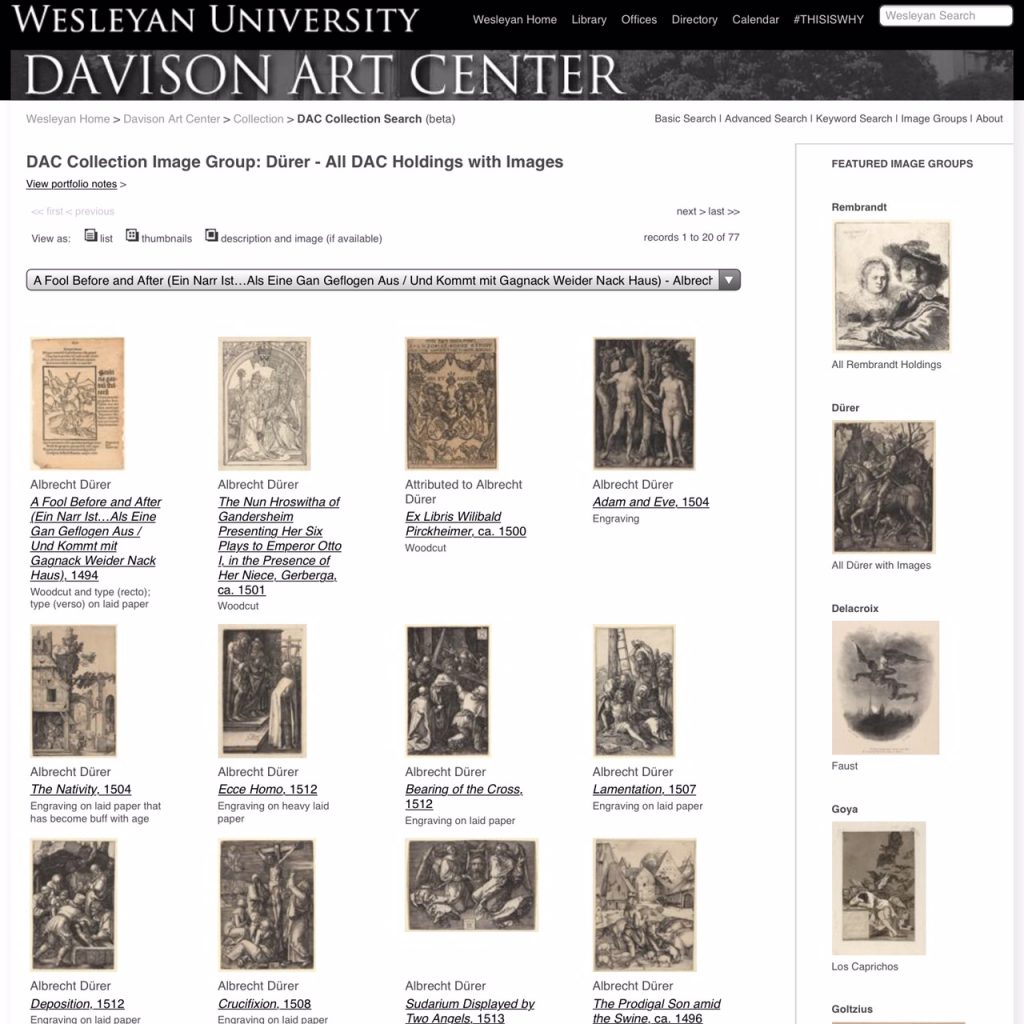
    The Davison Art Center (DAC) at Wesleyan University in Connecticut (United States) holds more than 25,000 works on paper, chiefly prints and photographs. The DAC collection serves teaching, study, research, exhibition, and other educational purposes. This includes public sharing of high-resolution images of collection objects which are themselves free of copyright. These images have been provided in growing numbers since 2012 as DAC Open Access Images, which may be freely discovered and downloaded via DAC Collection Search.

    DAC Collection Search offers text-based catalog records for nearly the entire collection, along with (to date) 4,590 downloadable DAC Open Access Images representing most of the DAC’s European prints from the 16th through 19th centuries. High-resolution, zoomable images of those 4,590 prints also are available for viewing online. A shortcut relevant to Coding Dürer leads directly to links to all DAC Dürer holdings with images.

    Each DAC Open Access Image is provided for free public download and use in two versions: a publication-quality TIFF (4,096 pixels long dimension) and a presentation-ready JPEG (1,024 pixels). A ReadMe offers technical guidance for image users. These images may be freely used under the DAC Open Access Images policy, which applies to DAC images that have no known copyright restrictions. Please see that policy for details.

    DAC cataloging metadata for these images (as well as for other collection holdings) may be freely downloaded from the same DAC Collection Search pages in two forms: structured LIDO XML and a basic, human-readable text caption in English. In order to make it as useful as possible for projects working across multiple collections, this metadata is provided under the Creative Commons CC0 1.0 Universal (public domain dedication) license.

    Most of the images of British, Dutch, and German prints (and thus, the Dürer images) were made in 2015 or 2016 during the first two of three summers of grant-funded digital photography of DAC collection objects. This digitization project was made possible in part by the U.S. Institute of Museum and Library Services (IMLS).

    Development of DAC Collection Search is ongoing. It may be offline on occasion for updates and improvements between 5:00 and 7:00 PM Eastern time (GMT -5:00h or -4:00h, depending on season).

    #musetech #museweb #opencontent #openglam #codingdurer #digitalarthistory @wesleyan_u @roblancefield


  • Mapping Titian—Data Source Description

    Mapping Titian is a site that allows users to visualize one of the most fundamental concerns of the discipline of Art History: the interrelationship between an artwork and its changing historical context. Focusing on the paintings executed by the Venetian Renaissance artist, Titian (ca. 1488-1576), this site offers a searchable provenance index of his attributed pictures and allows users to create customizable collections of paintings and customizable maps that show the movement of the pictures over time and space with the application of various filters. The collections and maps can be shared with other users or can remain private. The site also includes a glossary with short biographies of patrons and collectors of Titian’s pictures and references with a selected bibliography of relevant scholarship. The main goal of Mapping Titian is to create a tool from which new research, discoveries, and experiences can be inspired, guided, and shared. The site was developed with a grant from the Kress Foundation by Jodi Cranston, Department of the History of Art & Architecture, Boston University, Boston MA. We encourage the Coding Dürer participants to register as users of the Mapping Titian site and will be happy to showcase any of the results from the event in March!

    The paintings by the 16th-century Venetian artist have proven to be an especially rich microcosm of possible directions for a mapping platform currently under development, Mapping Paintings, of which this current site would be one part. Titian’s pictures involve a variety of conditions and circumstances—a celebrity artist with a publicized reputation during and after his lifetime, the international city of Venice, a reliance on travel and letters for communication and exchange—which also play a role in the “lives” of artworks in successive time periods.  

    The data used to generate the Mapping Titian site can be accessed through the excel spreadsheet, which can be accessed here for the Coding Dürer event. There are two pages to the spreadsheet. The first page lists each painting with the unique identifier of a painting number and the fixed information about that painting. The second page lists each painting by its unique identifying number only and charts the changes of ownership and location (indicated by place name and longitude/latitude). Each painting number appears every time there is a change in ownership and/or location. Some paintings are listed only one time and others appear with more than 20 entries. There are additional notes and color codings on the spreadsheet which are not important for this event.  

    Provenance map of Titian’s Europa from 1550-2014
  • Europeana—Data Source Description

    Europeana is Europe’s digital platform for cultural heritage, providing online access to over 54 million digitised items  (from books, photos, and paintings to television broadcasts and 3D objects) from over 3500 cultural institutions across Europe in 31 languages. 20.8m records allow free reuse. In Europeana Art, our dedicated thematic collection for art and art history,  you can browse 1.4m objects, search by topic, artist, or colour, and explore specially curated exhibitions.

    You can access Europeana’s content either by manual download or via the Europeana APIs. We currently have four free-to-use APIs (accessible by a simple registration process) and we encourage you to register for your preferred API keys before the Coding Dürer event. The REST API is our key resource and most used API. It enables users to filter records by a wide variety of metadata fields  – from the metadata submitted by our data providers (e.g. date, creator) to the technical metadata we extract from the linked media files (e.g. image size or video duration) and the semantic enrichment from linked open vocabularies (e.g. enrichment for period, location, events, or persons). The Europeana Linked Open Data service allows you to explore, access, and download metadata through the SPARQL endpoint provided by Europeana. With the Europeana OAI-PMH service, users can harvest the entirety or a selection of, Europeana metadata. Finally, the Europeana Annotations API allows users to generate, update, and retrieve short descriptions for objects in our collections. Users can access comprehensive and regularly updated documentation on Europeana Labs and find answers to your questions on the Europeana API forum.

    On Europeana Labs you can also find nearly 90 thematic datasets containing high quality, openly licensed, and directly accessible items on topics ranging from art, design, and architecture to World War I. We also showcase reuse tools and examples of games, apps, and other creations that use the Europeana API and content. We hope to add interesting and innovative outputs from Coding Dürer to this list!

    Contact Nicole McNeilly if you have any questions or talk to Douglas McCarthy, Europeana Art & Photography Collections Manager, at Coding Dürer in March.

    Source

    Comment

    Format

    Licence

    URL

    Europeana Collections

    Data description (above)

    Europeana Data Model  (EDM)

    Various

    http://labs.europeana.eu, http://www.europeana.eu/portal/en