Tag: Open Data

  • Project Groups (5) – Dutch Church Interior Paintings

    Project Groups (5) – Dutch Church Interior Paintings

    [The following text is written by the project group “Dutch Church Interior Paintings”. You will find more information on their project soon on their website, which will be linked here.]
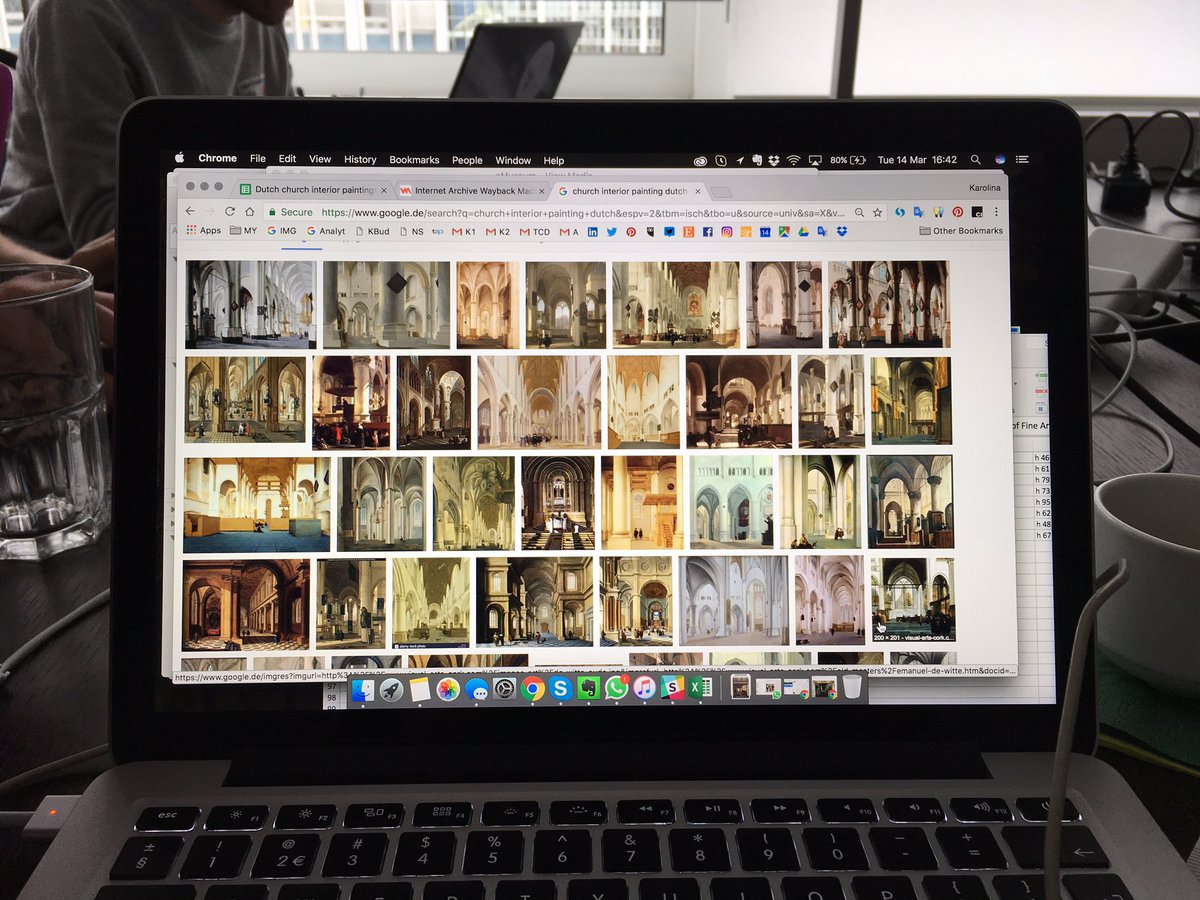
    The genre of church interior paintings has developed in the Netherlands in the middle of the 17th century and lasted only a few decades. It is represented by a relatively small group of specialized artists, such as: Pieter Jansz Saenredam (1597-1665), Emanuel de Witte (1616-1692), Hendrick Cornelisz Van Vliet (1611-1675), Gerard Houckgeest (ca.1600–1661), Anthonie De Lorme (c.1610-1673) and others. In many cases, the same church’s interior was depicted by the same artists dozens of times, however, the iconography, composition and vantage point (a position from which the interior is viewed) varied. One of the main factors in the development of this type of painting was the Reformation and its consequences, particularly the Calvinist approach to art. The so-called Beeldenstorm in 1566, a series of events during which churches were plundered and their Catholic decorations removed or destroyed, was a starting point of this far-reaching transformation of church interiors in the Netherlands. The churches became obsolete civic spaces filled with everyday activities, not exclusively restricted to preaching the God’s word any more. The altars, statues and other decorative elements were replaced by white-washed walls and simple panels filled with biblical excerpts instead of representations of saints and miracles. This is reflected in the church interior paintings, where we can see, for example, a woman breastfeeding, children at play, groups of gentlemen involved in conversations about business, couples strolling down the aisles, beggars and even dogs urinating. The latter was perhaps the strongest symbol of this transition of the church as a building: from a holy temple to a civic, urban and mundane space.
    There are hundreds of church interior paintings scattered across collections around the world. The research of this subject to date has focused mainly on particular artists or churches, rather than the overall genre and its network of artists and places. This project, born at Coding Dürer 2017, addresses this issue by providing a platform for further research on the paintings and creating an insight into the bigger picture of the genre for the first time. This visualisation of over 200 paintings of 26 different churches by 16 different artists was created with the following research questions in mind:

    • In what places the artists were active and in what places they depicted church interior(s)?
    • Did the artists have ‘favourite’ church interiors?
    • In what places and when could the artists possibly meet?
    • What church interiors were depicted the most?
    • What church interiors were depicted by most artists?


    DATASET

    The starting point of the project was a spreadsheet listing the paintings, artists, collections, etc. that was created for research purposes 2 years ago. This re-purposed data needed cleaning and additional information, e.g. IDs (artists, churches, paintings), locations (longitude, latitude), stable URLs for images.


    GOAL

    To create a map/visualisation that shows:

    1. Dutch churches depicted in the paintings (25)
    2. Artists’ activity (16+)

    TOOLS


  • Project Groups (4) – Meta Data Group

    Project Groups (4) – Meta Data Group

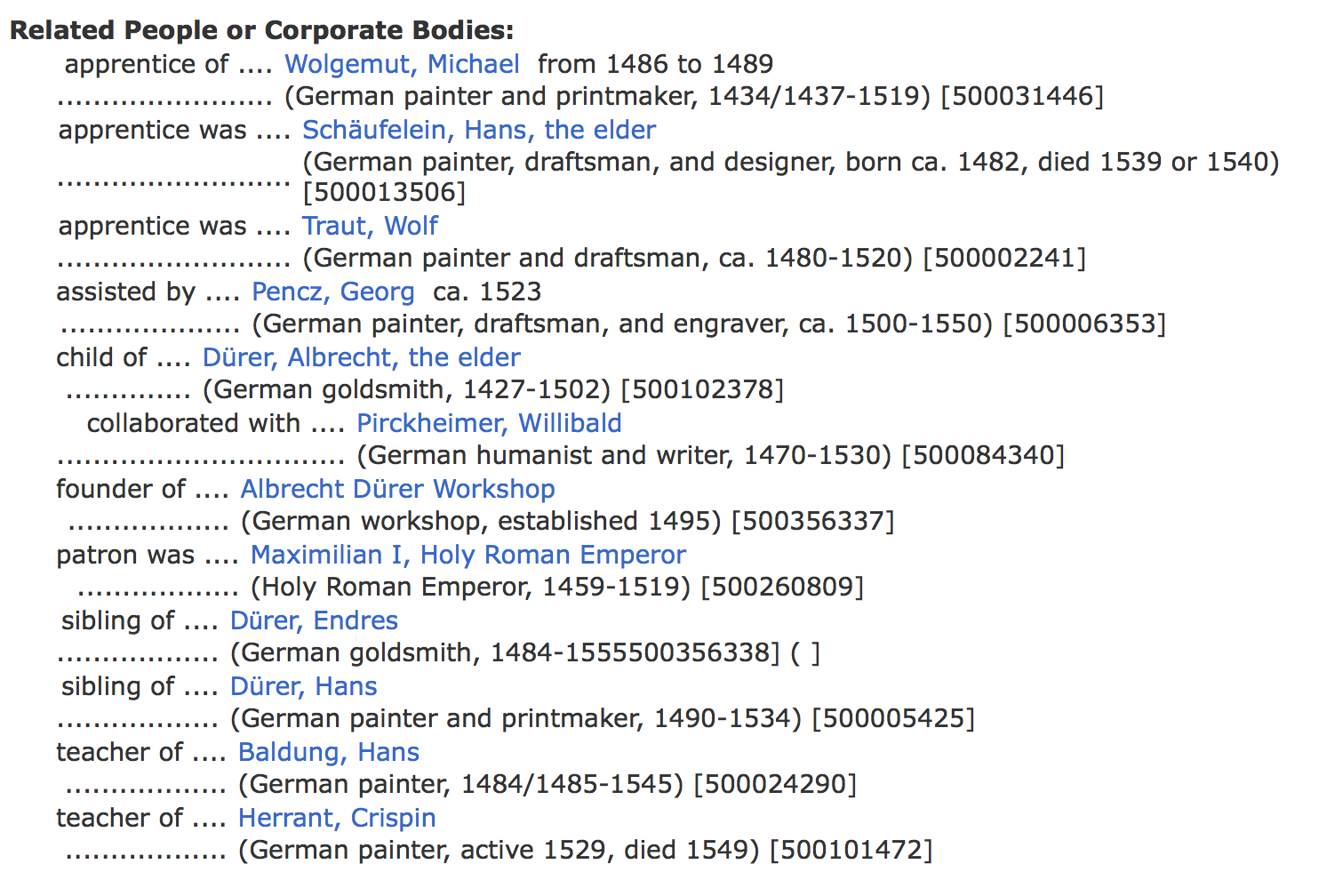
    The topic of visualization is quite popular at Coding Dürer. We already saw an approach in visualizing interactions of photographers with an artwork as well as an attempt to show how the work of an artist moves around the world throughout time. The “meta data group” engages in a project that relates to the person who gave the Hackathon its name: Albrecht Dürer. The group wants to show to whom and how the artist was related. By creating a graphic plot they want to answer the question of the artist’s relationship to his contemporaries in a way that is intuitive and easy to understand. The main challenge the team faces is to find data that fits their research question. ULAN, thUnion List of Artist Names from the Getty Research Institute, might offer a solution, as its data is organized in a network of categories like “assistant” or “teacher” which the team uses in recreating a network.

    Screenshot of ULAN data (a standardized list of artist’s names)
    The data that ULAN provides (as well as data from online research) can be visualized with the help of WebVowl and Gephi.
  • Project Groups (3) – Tracing Picasso

    Project Groups (3) – Tracing Picasso

    Photo by @airun72

    Throughout his life Picasso created a huge body of work, including paintings, drawings as well as sculptures, that travelled around the world. It seems impossible to grasp how and where the objects moved. One project group at Coding Dürer tries to solve this problem and help us understand the provenience of Picasso’s work by using digital tools. They use OpenRefine to handle the metadata provided by the Met Museum and the MoMA. D3 offers great timeline librarys to visualize time and place. Combined with information about Picasso’s life and exhibitions their interactive tool can show us how Pablo and his work moved throughout time.

  • Project Groups (2) – Albot

    Project Groups (2) – Albot

    Photo from Wikimedia

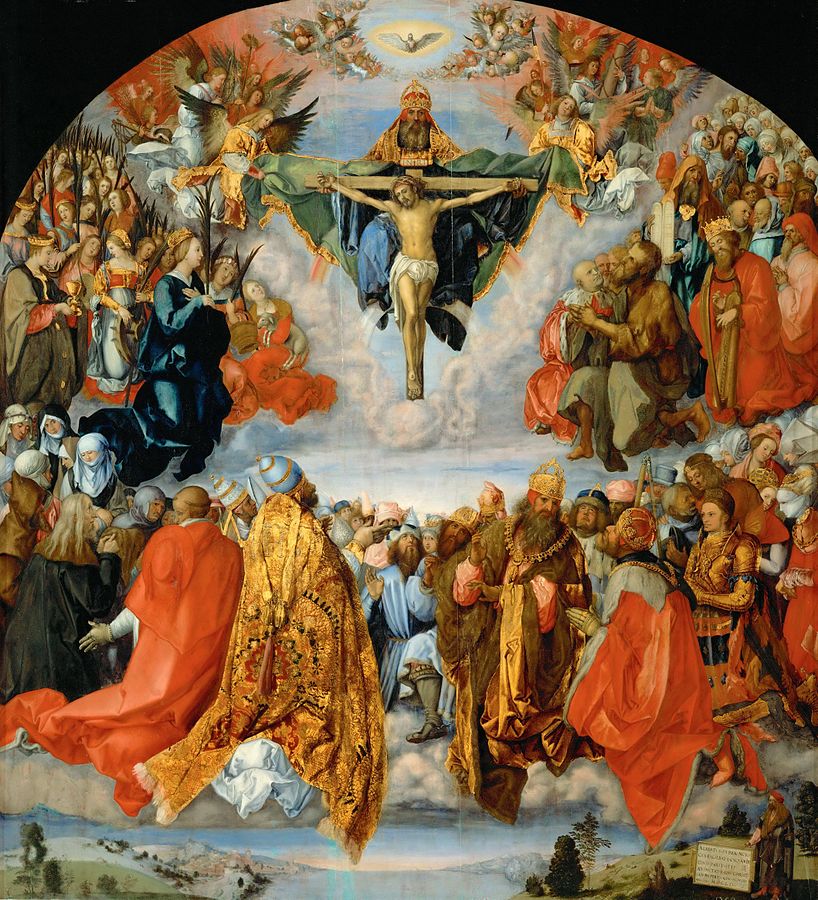
    You’re at a museum and want to find out more about an artwork you like? Then just ask Albot, the art history chatbot. He will access the museum’s metadata for you and answer simple questions about the artwork, like: Who’s the artist? What’s the title? Which people are depicted? At least that’s the vision of one of the project groups at Coding Dürer. They start with Albrecht Dürer’s “Allerheiligenbild” and try to formulate questions. By extracting keywords, Albot can understand questions and find answers. The team still tries to figure out which chatbot to use. Dexter or the Microsoft bot framework seem to offer great solutions.

  • Yale Center For British Art—Data Source Description

    Yale Center For British Art—Data Source Description

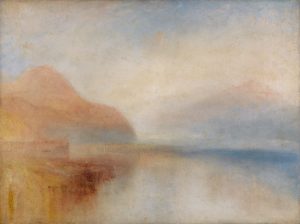
    JMW Turner, Inverary Pier, Loch Fyne: Morning

    The YCBA (@YaleBritishArt) has been sharing high-resolution images of its collection objects in the public domain since Yale University adopted its Open Access Policy in 2011, and today about 71,000 such images are available for download free of charge, including for commercial usage: http://britishart.yale.edu/collections/search

    The YCBA also makes its images available as IIIF assets. We publish a top-level collection that contains child collections for paintings, sculpture, etc.   The collections contain the IIIF Manifests for each object.   

    Machine readable YCBA data can be accessed currently by harvesting XML metadata (LIDO XML)and querying Linked Open Data semantic endpoint (data organized there with CIDOC CRM ontology). Access to or use of the Center’s data and services is subject to the Center’s Open Data And Data Services Terms of Use.

  • Museum für Kunst und Gewerbe Hamburg—Data Source Description

    Museum für Kunst und Gewerbe Hamburg—Data Source Description

    With approximately 500,000 objects from 4,000 years of human history, the Museum für Kunst und Gewerbe Hamburg (MKG) is one of Europe’s most important museums of art and design.

    The digitised and published parts of the collection are accessible online via MKG Collection Online.  The website features more than 10,000 artworks and artifacts. The LIDO-XML dataset that is provided via GitHub contains metadata of all the published records including links to the connected images, if available. More than 7800 images are reusable without any restrictions and can also be downloaded directly via the website. Please note our usage guidelines, if reusing images that are marked CC0 or CC BY 3.0. The collection can also be accessed via the websites and APIs of Europeana or Deutsche Digitale Bibliothek but the data updated most recently is the LIDO-XML on GitHub.

    A tool that has been developed during the hackathon “Coding da Vinci Nord” as part of the “Zeitblick” project and that can be useful is the MKG Downloader. This tool lets you filter items from the LIDO-XML and download them.

    The metadata includes information about artist/actor, actor role, object type, title, eventtype, date and place, material, technique, dimensions, marks and inscription, classification, iconography/subject, depicted persons, depicted place, description and rights metadata. The vocabulary used for cataloguing is in large parts linked to the Integrated Authority File (GND), to Wikipedia and Geonames, as well as to thesauri like Iconclass and the Art and Architecture Thesaurus (AAT). All persons and corporate bodies are linked to their respective GND record, if available.

    The datasets are placed in the public domain using a CC0 License.

    If you find any errors or want to provide additional information, please let us know.

    Contact: Antje Schmidt, Head of Digital Cataloguing and MKG Collection Online

    Email and Twitter

    #mkghamburg

  • Nationalmuseum Sweden—Data Source Description

    Nationalmuseum Sweden—Data Source Description

    About Nationalmuseum

    The Nationalmuseum in Stockholm is Sweden’s premier museum of fine art and design. Founded in 1866, the institution holds the growing national collection of older art up to around 1900 and older applied art as well as design up to the present day.  Our mission is to preserve, make accessible and provide knowledge about the collections we hold. Nationalmuseum is currently under renovation and will reopen to the public in 2018. 

    The Data

    The digitised collections of the Nationalmuseum Sweden are largely accessible via Europeana.eu where artworks that no longer are protected by copyright are licensed with CC BY SA or marked Public Domain. We would like to raise special attention to a dataset of around 3000 paintings which were made available on Wikimedia Commons last autumn.  Metadata to the images is reachable on Wikidata  and we  published the LIDO XML of all artworks as a zipped file on GitHUB. The XML holds information on the artist, title, media- and dimension information and often information on the depicted persons of the artwork. Each dataset includes a link to an iiif-resource, so that the image material can be used as flexible as possible. 

    The information has been collected in the internal database of the Nationalmuseum over a long period of time and might occasionally be incomplete or erratic. Additional data or corrections are welcome.  

    Contact Karin Glasemann via Twitter or Email

    .

  • Get #InspiredbyEuropeana at Coding Dürer

    Get #InspiredbyEuropeana at Coding Dürer

    Are you one of the art historians and data-scientists taking part in the Coding Dürer hackathon? Do you want to know what Europeana offers for research? Like the organisers of Coding Dürer, we believe that digitized cultural heritage content has huge potential for digital humanities and multidisciplinary research.

    Europeana offers the hackathon participants access to more than 54 million digitised items and related metadata from more than 3500 of Europe’s galleries, museums, archives and libraries. Europeana Art is our dedicated thematic collection designed to promote discovery of Europe’s art. Here you can browse 1.4m objects, get inspired by specially curated editorial features and search by topic, artist, museum and colour. Encouraging people to give new life and meaning to our re-usable content – currently  20.8m records in our entire collection – is one of the ways we can harness the full value of cultural heritage.

    On Europeana Labs you can access a range of resources and services to help you get working with our cultural collections as quickly and as easily as possible. There, you can find a showcase of tools and applications built using the Europeana API and a series of openly licensed datasets featuring the best free-to-re-use Europeana content. We have made available four Europeana APIs –  all are free to access and use after a simple registration process. The REST API is the most frequently used – it enables users to filter records by a variety of data fields, from date and creator, to media type and size. The Europeana Linked Open Data service allows you to explore, access, and download metadata through our SPARQL endpoint. With the Europeana OAI-PMH service, users can harvest the entirety, or a selection of all Europeana metadata. Finally, the Europeana Annotations API allows users to generate, update, and retrieve annotations for objects in our collections.

    Your use of Europeana data does not have to stop at Coding Dürer

    On our platform you can also find funding and services to support creative, educator and researcher communities to reuse Europeana content. About twice a year we issue the Europeana Challenge, a themed call to creative professionals to present their best business ideas for the re-use of Europeana content. Outcomes are varied; business-oriented or educational, social or creative, but the proposals must be sustainable and meet the theme (which in the past has included fashion, art, and World War I). In 2017 we have also launched the first Europeana match funding call offering financial backing for proposed secondary educational resources using Europeana content.

    Europeana Research provides opportunities for digital humanities researchers to answer a specific research question using Europeana content and research datasets. The annual Europeana Research Grants programme, first launched in 2016, is designed to support researchers employing  digital humanities tools and methods to make the most of the full resources of Europeana (metadata, the API, etc.) to further their research.  You can also become a member of Europeana Tech, our R&D community with a special focus on cultural heritage.

    We are pleased that the team at Coding Dürer has facilitated this hackathon of art history data. We are even more thrilled that we have the opportunity to encourage you to explore beyond interdisciplinary research boundaries with Europeana’s art data. If you use our content or API, please share your progress with us on Twitter using @EuropeanaLabs and #CodingDurer. We are interested in featuring any promising ideas or prototypes that come out of the Coding Dürer Hackathon on Labsemail us to show us more. For now, all the best for a productive and inspiring week at Coding Dürer – we are looking forward to seeing the outcomes. #Allezculture!

    Stay in touch!

    Europeana Labs website / newsletter sign up / Twitter / email us
    Europeana Research website / Twitter
    Europeana Tech website / Twitter  


  • RKD-Netherlands Institute for Art History—Data Source Description

    About the RKD

    The RKD is a renowned documentation and research institute. As a knowledge institute we work in collaboration with museums, heritage institutes, universities and private institutes. Members of our staff are involved in research, publications and organising events. We harbour unique archives, documentation and photographic material and the largest art historical library on Western art from the Late Middle Ages to present, with the focus on Dutch, Southern and Northern Netherlands, art. Our collections contain information on tens of thousands of paintings, drawings and sculptures, but also cover monumental art, modern media and design.

    RKD is publishing substantial parts of its data through (beta) web services. All sets are made available under ODbL-BY  (Open Database Licence – Attribution). Note: this licence is for the metadata only. Images are not licenced, although they might be in the public domain. RKD is currently exploring the options around Open Access and Content. All suggestions are welcome.

    RKDimages web service (OAI-PMH)

    The RKDimages web service is made for application developers and others who want to consult the data from RKDimages in machine-readable format. Through this web service descriptive data  is offered for around 240,000 works of art from the Middle Ages to the present day. 

    This data set is made available under ODbL-BY  (Open Database Licence – Attribution). The web service works on the basis of the Open Archives Initiative Protocol for Metadata Harvesting OAI-PMH. The format is RDF and using DC-Terms, FOAF en Schema.org: namespaces.

    Please note that the license concerns the descriptive data. Images can be retrieved in low resolution with watermark, but these are not yet available as open content.

    RKDartists web service/Open Search (EAC-CPF)

    This is a derivative set of biographical data from the extensive dataset RKDartists&. Containing biographical data of some 250,000 Dutch and foreign artists from the Middle Ages to the present. The ampersand in the name indicates that also art dealers, art collectors and art historians are included in this database. RKDartists serves also as an index to the extensive art historical documentation of the RKD. That analog documentation (images, archives, press documentation and literature) can then be viewed at the RKD. RKDartists is used by other (Dutch) heritage institutions as authorized name authority file in their own collections.

    The displayed elements are made available under the Encoded Archival Context for Corporate Bodies, Persons, and Families (EAC-CPF) standard. Each object (artists record) can be accessed via a URI (Uniform Research Identifier). Also there is in the data a deep link to the full record in RKDexplore.

    This data set is made available under ODbL-BY  (Open Database Licence – Attribution).

    And ICONCLASS as LOD

    Iconclass is a classification system designed for art and iconography. It is the most widely accepted scientific tool for the description and retrieval of subjects represented in images (works of art, book illustrations, reproductions, photographs, etc.) and is used by museums and art institutions around the world. So you can find the iconclass codes in many collection information systems. Although it’s considered a complex system with a high learning curve, Iconclass is second to none as a system for art (historical) subject annotation. The Iconclass system is accessible through the Iconclass  Browser and available as Linked Open Data (LOD)

    Please check the list of data sources for more information on these data sources

  • Albertina, Vienna—Data Source Description

    Albertina_Logo

    The Albertina safeguards one of the most important and extensive graphic art collections in the world. It comprises around 50,000 drawings and watercolours, as well as some 900,000 graphic art works, ranging from the Late Gothic era to the present.

    The arc of exquisite works stretches from Leonardo da Vinci, Michelangelo Buonarroti and Raphael Santi through Albrecht Dürer, Peter Paul Rubens and Rembrandt Harmensz van Rijn to Claude Lorrain, Honoré Fragonard and Paul Cézanne. In the modern section, the holdings range across Egon Schiele, Gustav Klimt and Oskar Kokoschka via Pablo Picasso and Jackson Pollock to Robert Rauschenberg, Andy Warhol, Alex Katz, and finally to Franz Gertsch, Georg Baselitz and Anselm Kiefer.

    Albertina is publishing a wide range of its works that are free of artist’s copyright in the Europeana collection. For CodingDürer Albertina is providing metadata from all its artworks that are published in Europeana collection. These datasets are placed in the public domain using a CC0 licence.
    Images are not included and are not part of the dataset.

    There are about 58.000 objects published in Europeana, amongst them about 40.000 drawings and prints from the Graphische Sammlung, 9.000 objects from the Fotosammlung, 5.500 objects from the Architektursammlung, 3.700 objects from the Plakatsammlung and some objects from the Gemälde- und Skulpturensammlung).

    Albertina is providing the following metadata concerning the work of art: title, creator, classification type, medium, size, creation date, provenance, identifier (= inventory number), institution, providing country, collection (is part of: Graphische Sammlung, Fotosammlung, Architektursammlung, Plakatsammlung, Gemälde- und Skulpturensammlung).