Category: Meta

This is about Coding Dürer

  • Thank you very much!

    Thank you very much!

    Coding Dürer has been a dream once. Then it has been a third-party funding project. Then an organizational knot to untangle. And then it became true.

    Forgetting the sweat, I am very very happy about the process and outcome of Coding Dürer. Plus: Nothing went seriously wrong. A project like this wouldn’t be possible without the help of many.

    Here is a–probably still incomplete–list of those people I wholeheartedly like to thank:


    The Volkswagen Foundation and particularly Vera Szöllösi-Brenig for making this event financially possible. All food, drinks, trips and rooms are on them! We are indebted and will report back the results of this event.

    Natalia Karbasova and Patrick Müller from Hubert Burda Bootcamp for kindly hosting us and helping out in many situations.

    Sonja Gasser in helping me securing the funding from Volkswagen Foundation and in particular for designing the great Coding Dürer logo.

    Philipp Hartmann for the logistics of food and technology and in particular for being reliably at the right place at the right time.

    Nuria Rodríguez Ortega, Anna Bentkowska-Kafel, Lev Manovich, Justin Underhill and Mario Klingemann for their friendship, inspiration and believe in my pursuits.

    Hubertus Kohle for giving me the opportunity and freedom to engage in those pursuits.

    Liska Surkemper from the International Journal for Digital Art History for her wonderful support.

    Christian Waha, from Industrial Holographics, for kindly providing the Hololense. We will never forget.

    Christian Soellner and Florian Thurnwald from Microsoft for making their visit possible on very short notice.

    Douglas McCarthy and Barbara Fischer for their invaluable advice and experience and in particular for framing this event into a wider context.

    The many data providers, in particular those, who contributed to our list and blog. You are our partners.

    All following and contributing to #CodingDurer on Twitter. You have been an integral part of this event.

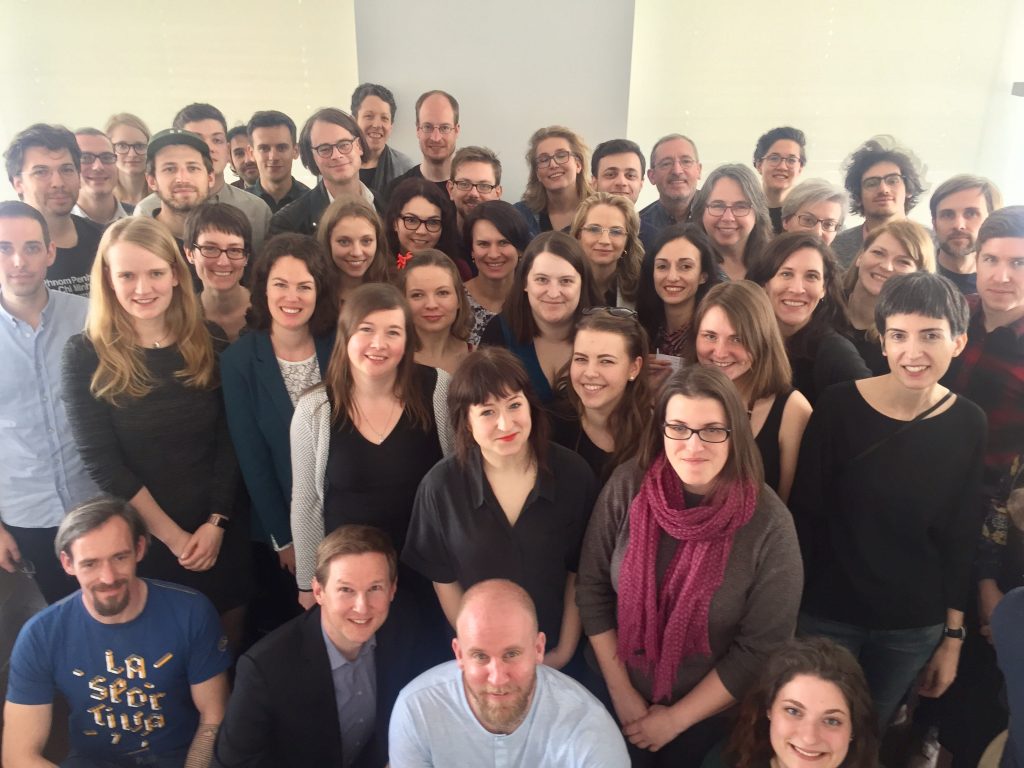
    And last, but not least, all participants. You have been working hard and made this event the success it is.
     

  • A moment to report

    A moment to report

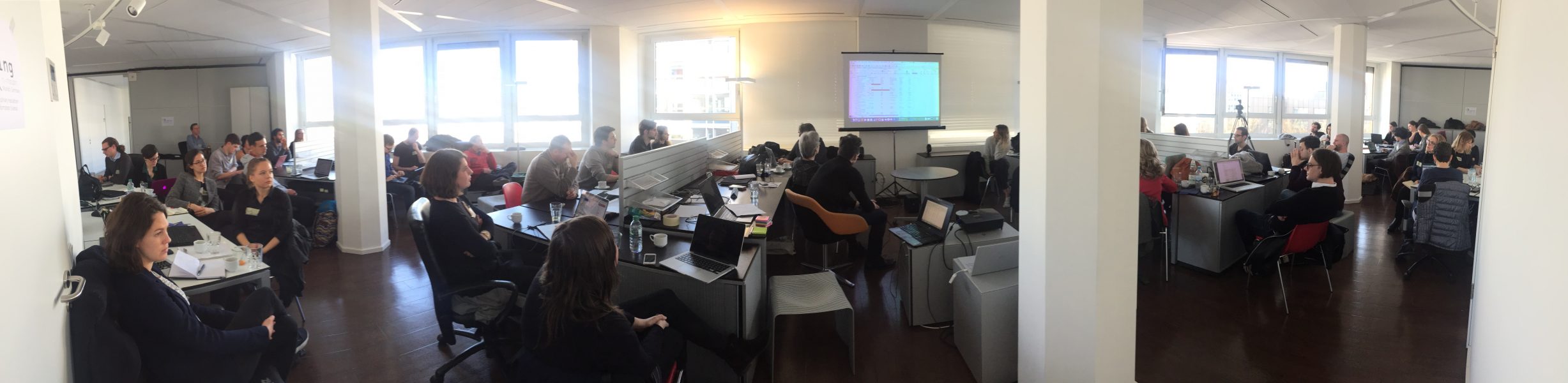
    It is quiet today. A few voices and keyboard tapping. Today is working time.

    Since it is also quieter for me, let me report, what we have done so far.

    On Monday, we had a lively discussion on the subject of data, data analysis and data visualization in the context of art history. Many aspects came up from the truth of data, the necessity of cleaning and the viewpoint of the end-user. The question was raised how art-historian and information scientists can work together even if there is this perceived gap. That gap consists of different approaches, ways of thinking and even concepts associated with particular terms. It was agreed, however, that we have to be the agents of change we want to see. This group is such a diverse group of people from different backgrounds that the fruitfulness of interdisciplinary collaboration—that is the flip side of the coin—can probably nowhere better be yielded than here.

    There were also solutions proposed how to fill that gap:

    1. It needs time to work together.
    2. It needs communication, including visual communication (flipcharts are available).
    3. It needs translators, who can bring the fields together.
    4. It needs a shared vision. If everyone knows the goal it is easier to do the first step.
    5. It needs an interdisciplinary mind-set of openness and cognitive flexibility.

    Are there more elements that you think are important? What are your experiences? Let me know in the comments below or via Twitter @HxxxKxxx.

    Then we were talking about data sources and on Tuesday gathered a list of tools. And after a Post-It wall of ideas we formed 8 project teams that started working together. Here is the list of preliminary group names:

    1. Church interiors
    2. Group One (later renamed Picasso Group)
    3. The Americans
    4. The Associatives
    5. Metadata Group
    6. Image Similarity Group
    7. Generative Machine Learning Group
    8. Chatbot for Exhibitions

    Additional input came from contextualising Lunch Talks by Nuria Rodríguez Ortega and Anna Benkowska-Kafel and the very inspiring Evening Talk with Lev Manovich. Also the Lightning Talks, where everyone had the chance to present their home project, showed what a fantastic group comes together here.

    All participants are now in high activity, discussing and gesturing in front of displays. That is wonderful to watch… Today we are looking forward to listening to the Lunch Talk by Justin Underhill (Berkeley University) and tomorrow by Mario Klingemann (Google Fellow). On Friday we will be presenting the results in a public event in the Department for Art History.

    You can follow those parts of the event via live streaming. Past lectures are also archived. You can also follow us on the Twitter hashtag #CodingDurer which is populated with many tweets not only from participants. Here you can contribute and get into a conversation, bring forward your own projects and ideas. We also try to keep you up-to-date on our blog. Have a look at it from time to time.

    We would like to have the global network be part of the event and interweave their talents into our group.

    You can also see an overview of Day 1 and Day 2 on Twitter.

    That’s it for the moment from me.


  • How to get involved with Coding Dürer

    How to get involved with Coding Dürer

    We have received more than 160 applications from all over the world to participate at Coding Dürer and many have engaged with us since then via social media. There is a strong interest in taking part in the event. 

    Here is the good news: We like to have as many people involved in Coding Dürer as possible. Read on to see how you can be part of it.

    Via Social Media

    Social Media are not only a channel to push news, but to interact.

    We would welcome if you follow our hashtag #CodingDurer at Twitter, get in contact with users, reply to tweets and ask your own questions. 

    Via Livestream

    We are offering parts of the event as livestreams. 

    Take a look at the list of streams and be online when our speakers give their presentations.

    Via Public Event

    The presentation of the project results will be public at the Department of Art History, Zentnerstr. 31 (Room 007) on Friday, 17.3., at 15:00.

    You are welcome to join us and be part of the conversation.


  • Application turnout

    We are very impressed by the vast number of 159 applications we have received. That is four times more than we have places!

    This shows that the topic is of high interest and there exists an active global community. It was hard to make a selection out of all these fantastic people with very interesting backgrounds out of 31 different countries.

    We have now made a decision on the final participants—a diverse group of people from whom interesting results can be expected.

    Due to the enormous talents we have seen in the application process, we would also like to keep those involved into the event, who cannot be present in person. At first, we would like you to follow and contribute to the hashtag #codingdurer on Twitter and check our blog from time to time for updates. Before the event starts, we will tell you more details on how you can get involved online.

    You will find the preliminary schedule on our website http://codingdurer.de/schedule.html

    (We have sent out the notifications on January 16. If you have applied for the event and have not heard from us yet, please check your spam folder or get in contact with us again.)

    As written in our previous post, we invite interested institutions to join us and bring their data sources into the creative group of 40 people and see what happens. There are many options how you can present your data at the event. Please get in contact with us.


    Timestamps of applications during the application period


    Geographical distribution of applications (click to see details)


  • Collaborate Across Disciplinary Boundaries

    Art History and Computer Science are two disciplines with different approaches in doing research. Nevertheless, the digital material on art that is increasingly provided by museums or other cultural institutions with their online collections is interesting for both sides. While art historians have new possibilities to access, use, analyze and interpret their source material, computer scientists find datasets of artworks and thus images and metadata with quite particular characteristics. The challenge for art historians is to acquire the necessary technological knowledge and to apply suitable tools in order to draw upon the strengths a digital workflow offers. These are prerequisites for being able to adequately apply the advantages of technology to study art history in a digital environment and, at the same time, to establish new methods for the discipline. Computer scientists are interested in cultural data as a basis to develop applications and tools. Or they are curious to test it with existing prototypes to see what modifications are in need that these remain useful for that kind of data. This coincides with recent advances in computer science that particularly include topics in areas with a focus on visual data, like computer vision or machine learning with images, as well as all aspects around information retrieval and the semantic web.

    Several interesting resources from cultural institutions exist such as the Rijksmuseum, the Tate, but also on Europeana that provide images of artworks from their collections or at least the corresponding metadata that can be reused. The Getty Vocabularies, e.g., the United List of Artist Names (ULAN), are a powerful resource to enrich the metadata provided by the museums. Such a record includes information about spelling variants of the artist’s name across different languages, her or his birth and death place, further biographical facts and relationships with other artists. This small overview alone makes clear that technologically far more is possible than just using the databases to find images through a search mask and use these to traditionally study the artwork, compare it with other examples and write a text about it. Instead, by using the power of the semantic web, networks can be created with computational methods and allow to get an overview about a specific data set, which ideally allows to get new insights, different interpretations and interesting conclusions. Numerical values, such as color, amounts of digital objects or information etc., can be processed easily with computer technology. This means that statistics become important, what is contrary to the usual methods in art history. To use the data provided in digital art collections, e.g., in a data visualization – good examples can be found on Google Arts & Culture Experiments –, it is necessary to have the ability of how to use these APIs.

    There is often a gap between the knowledge and the skills of art historians on the one hand and computer scientists on the other. Whereas in art historical projects usually a satisfying use of technology is missing, innovative applications that use digital art collections are often interesting from a technological point of view and allow to predict future developments of, e.g., image search methods, but lack of providing in-depth knowledge of wider art historical relations or cultural contexts that are related to the artworks from different periods. It is important to take both sides equally into account for sophisticated tools or applications. Therefore, the idea of Coding Dürer is to offer art historians and information scientists a chance to collaborate in mixed groups to find challenging ideas and to initiate a fruitful dialog between both disciplines. The main focus is to enable the collaboration in interdisciplinary groups. This means that the largest part of the time is reserved to work on small, experimental projects with the aim to present a prototype at the end of the week. A few presentations by invited speakers during the week offer inputs from other perspectives. It will be also possible that participants give an insight in own projects that are of interest for the plenum.

  • Open Data. Open-ended

    The word “hackathon” is a blend of the words “hack” (in the sense of exploratory programming) and “marathon”. The hackathon Coding Dürer is modeled after the hackathon Coding Da Vinci organized by the Open Knowledge Foundation, Wikimedia Germany and others. Its goal is to encourage institutions to liberate their data and bring this data into a creative context from which innovative projects might emerge. Hackathons are often built around industrial or communal data such as traffic data. Coding Da Vinci, on the other hand, expressively puts its focus on cultural data. In 2014, 17 digital cultural projects were realized using 16 datasets.

    We need open data. Only if data is available to the public, citizens, scientists, coders are able to use them for ends that no one has thought of before. That entails of course that the resulting data and code is open as well.

    We need an open end in the project. There are no limits as to what can be done. There are no restrictions set by the data suppliers as to what should be done. The end of the project is open in order to fuel creativity. No targets are set in order to yield fascinating results. 

    The purpose of Coding Dürer now is quite similar to Coding Da Vinci: Open data and open-ended. Its focus, however, is on art-historical data and to bring art historians and coders together. What can we do with art-historical data? What insights into art history might we gain? How can data visualizations give us an understanding of art? How can we build meaningful applications upon those data? How can we bring this data into a context never thought of before?

    Data sources might be:

    We invite interested institutions to join us and take the chance to present their data sources to the interdisciplinary group of 40 people and see what they are able to accomplish within those five days in March and possibly beyond. Please get in contact with us.


    The preliminary schedule of the hackathon will be published on this website soon. Please check back in a few days.

    Update: The list of data sources is available here.

  • A Spring School for Art History and Information Science

    logo_codingdurer_300dpi

    Digital Art History can only be successful in close cooperation with Information Science. At the same time, Information Science has a great interest in working together with the visual Humanities and their cultural content. Working with mixed methods from both disciplines promises interesting results from which both sides benefit.

    This is reason enough to bring 40 people from both disciplines together and let them work with art-historical data. What can we do together? How can we combine qualitative and quantitative methods? What mutual relation does distant and close viewing have to each other? How is a mixed methods approach feasible?

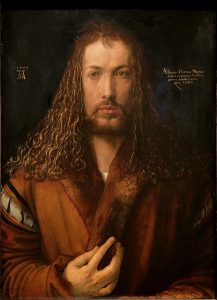
    This should be experienced in a Spring School on March 13-17, 2017 in Munich at “Coding Dürer”. Why Dürer? The German Renaissance painter Albrecht Dürer has been one of the most innovative artists of his time and open to new imaging technology. If you come to Munich, you will be able to see his 1500 self-portrait in which he shows himself as the personification of progress and pride in art production. What a better patron could we choose to preside over a week of coding, data analysis and visualization?

    We are happy to receive funding for this event from the VolkswagenStiftung, to have the International Journal for Digital Art History as a partner and to have won the following keynote speakers for the event:

    And now we want you to apply until January 10 to participate at this event. For more information, please go to http://codingdurer.de and if you would like to follow us, check #CodingDurer

    Dürer
    Albrecht Dürer: Self-portrait in a Fur-Collared Robe, 1500 (Alte Pinakothek, Munich, oil on linden wood, 67 × 49 cm)